

So Afraid
Fear, Division, and Our Human Crisis

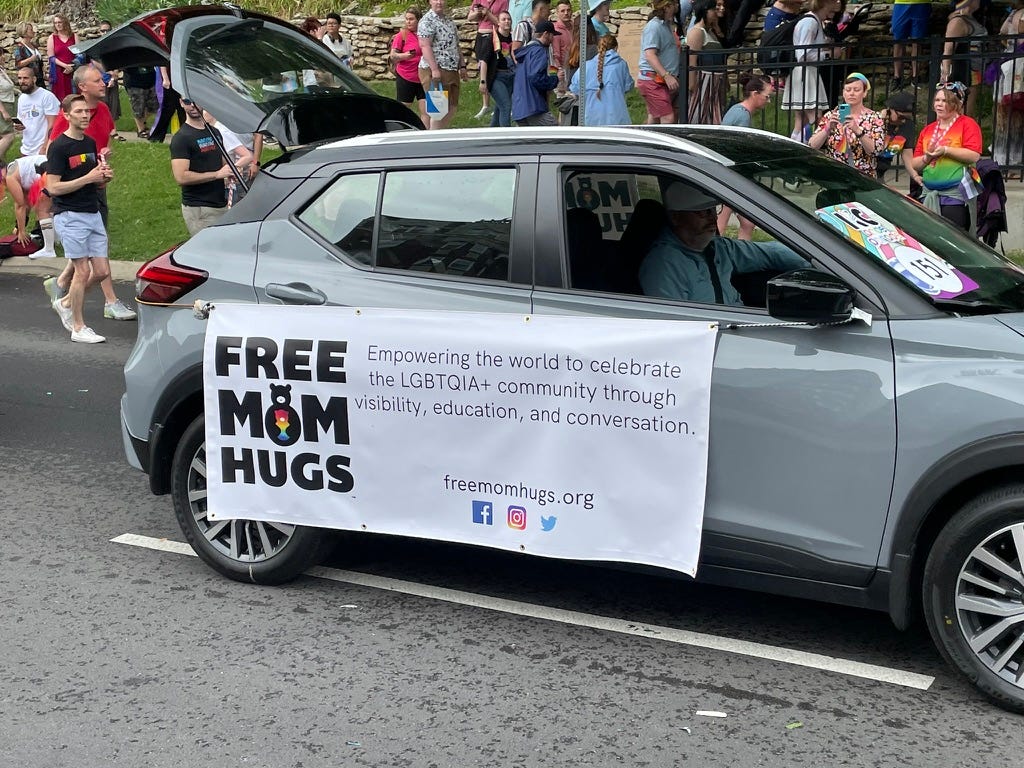
We’re in the final countdown to the 250th celebration of America.
I’ll return next week to my series that gives a roadmap forward, focusing on economics, FDR, and practical ideas.
But I’m going to take a short pause.
This week has been full of conversations about Graham Platner, our President’s fight club on the White House lawn, Hegseth’s narrowing view of Christianity and military talent, and other examples of men in power acting very small.
Locally, there was the usual hate thrown at the Pride Festival, and racism abounded after an incident with a group of teens at a suburban downtown festival, despite the clearly mixed crowd of rowdy behavior that caused it.
So this week, I want to focus on how fear drives our division.
I wrote about a similar theme after the first No Kings rally a year ago, and how that fear drives much of our conversations on race and gender.
Unfortunately, we need to revisit it, given that nothing, not even Black History Month, seems to unglue certain people like Pride Month.
Example? An acquaintance received death threats on her socials. The crime? Posting pictures from a Pride parade.
Imagine being so insecure about your sexuality, your gender identity, or your religion that you threaten a person’s life for taking a picture of people hurting no one and having a great time?
It’s madness. A madness of division that has long roots in our country.
One Minute of History: Frederick Douglass
There are fifteen incredible speeches and analyses in Ben Rhodes’ All We Say. As I recommended last week, pick it up.
But today, as I think about how to bring us together during Pride Month, I want to shine a light on Frederick Douglass’s “Composite Nation” Speech from 1869.
It comes on the heels of Reconstruction falling apart, our union, recently in war, still highly uncertain, and the South asserting its “Lost Cause” mythology.
The speech was prompted by a debate on Chinese Immigration, but it really created a thesis and mission for America’s great experiment: to become the world’s first to sustain a multi-racial, multicultural democracy.
It’s a sprawling speech, but three stanzas help to set the context for where we are today.
To those who doubt and deny the preponderance of good over evil in human nature; who think the few are made to rule, and many to serve; who put rank above brotherhood, and race above humanity; who attach more importance to ancient forms than to the living realities of the present; who worship power in whatever hands it may be lodged and by whatever means it may have been obtained; our Government is a mountain of sin, and, what is worse, it seems confirmed in its transgressions.
To the Hindoo, every man not twice born, is Mleeka. To the Greek, every man not speaking Greek, is a barbarian. To the Jew, every one not circumcised, is a gentile. To the Mahometan, every man not believing in the prophet, is a kaffe...Prejudice of race and color has been equally upheld. The two best arguments in its defense are, first, the worthlessness of the class against which it was directed; and, second; that the feeling itself is entirely natural.
What struck me in this speech was that prejudice, racism, and discrimination are universally practiced, so should be the antidote to those things. And that Douglass, despite being born a slave, fighting against that institution and racial prejudice every day of his life, believed that the United States had the potential to live up to those ideals.
A couple of weeks back, I asked that we rededicate ourselves and our nation as we push for the ideals and aspirations of our founding documents. Again, I turn to Douglass:
In whatever else other nations may have been great and grand, our greatness and grandeur will be found in the faithful application of the principle of perfect civil equality to the people of all races and of all creeds, and to men of no creeds. We are not only bound to this position by our organic structure and by our revolutionary antecedents, but by the genius of our people. Gathered here, from all quarters of the globe by a common aspiration for rational liberty as against caste, divine right Governments and privileged classes, it would be unwise to be fighting against ourselves and among ourselves; it would be madness to set up any one race above another, or one religion above another, or proscribe on any account of race, color or creed.
Yet, here we are. Continuing the madness.
There is something in the way of change. Douglass articulated it in 1869.
Rhodes summarized the competing forces Douglass observed: “those who welcome change and those who cling to a regressive order.”
And we are seeing and reading about that same tension today.
What is driving that disparate view of America?
Fear.
Fragility and “Soft Targets”
My son endured Boy Scouts all the way to becoming an Eagle Scout. If you ask him, he did so out of spite as much as achievement.
There were many good things and good people in the program. And, despite some of his experiences and mine, I still think it was a net positive for his personal growth. And mine.
Last summer, I shared the story of my wife’s conversation with a guy at Scout camp who believed he needed to carry guns.
Because everywhere he went, he was a “Soft Target.”
That was the dad of a kid who jumped on mine during a Cub Scouts meeting because my son had a propensity for talking and being happy.
The world, including us, wore that down in my son. He’s slowly climbing back out, but is still very guarded about his feelings and what he says.
It makes me sad that’s what we’ve done. And I feel sorry for the “soft target” and the kid who jumped my son.
In fact, I feel sorry for all of them, because they’ve been sold a bill of goods on what it means to be tough and what it means to be weak.
That comes up this month in particular. With Juneteenth and Pride Month coinciding, I see the weakest of men among us making the vilest of comments.
Most are hiding behind anonymous online profiles.
Pete Hegseth put exclamation points on that fear by removing all women and many Black service members from a promotion list. That was after he barred transgender troops from serving, which an appeals court recently ruled illegal.
He went further by creating a narrow view of Christianity, which excludes Unitarian Universalists and Mormons (although Trump made him reinstate Mormons), while dropping 200 religious designations.
Trump hasn’t recognized Pride Month, deters Embassies from celebrating it, and is planting a UFC fight in the middle of it.
That’s after removing Juneteenth and MLK Jr Day from the list of holidays people get into national parks for free, while adding his birthday to that list.
It seems clear that the White House will ignore the holiday again this year with all its focus on the cage match.
And there are so many men in the Manosphere who back him no matter what.
This includes 54% of Republican men who don’t think they could beat the President in a fight (compared to 71% of Democratic Women, and 82% of Democratic Men who think they could slap him around pretty easily).
The response from the media mirrors that lack of fight or even questioning of the Administration and its staunchest supporters.
What Too Many Get Wrong
Too many podcasts and media articles slip into labels really quickly. Racist. Misogynist. Toxic. And offer scant solutions.
For a deeper cut, we need to turn to researchers like Richard Reeves, who launched the American Institute for Boys and Men, where there are conversations ranging from gender equality with Gloria Steinem to the lack of connection for boys and depression to how we help boys move past porn to healthy romantic relationships.
Unfortunately, rather than tuning into that kind of content, men online get an onslaught of reels that poke fun at traits like empathy and compassion, positioning such things as weak or “soy” or “beta.”
The manosphere, and the women who are complicit, should recognize that empathy and compassion are elements of strength, going back to our best leaders in history, going back to Marcus Aurelius, who said:
I, then, can neither be harmed by these people, nor become angry with one who is akin to me, nor can I hate him, for we have come into being to work together, like feet, hands, eyelids, or the two rows of teeth in our upper and lower jaws. To work against one another is therefore contrary to nature; and to be angry with another person and turn away from him is surely to work against him.
My bottom line? We don’t have a masculinity crisis. We have a human crisis.
This is not unique to our time, but what is unique is the manipulation of media and messaging to make it seem as though the loudest voices are the dominant ones.
It doesn’t help that the world’s soon-to-be first trillionaire, Elon Musk, pushes so many of these hurtful messages, especially anti LGBTQ+ messages, on his platform X.
The biggest mistake that the media, and people more broadly, make is assuming a majority of men and women buy into that mythology.
They are not the majority. Period.
But those pushing the worst version of masculinity are loud, they are fearful, and we give them way too much credit.
We need to match Frederick Douglass’s strength. Our time is now.
Where Do We Go From Here
We need to take two steps forward.
One is short-term.
And it’s speaking up for our LGBTQ+ community. This shouldn’t be super hard for people. The majority of us want to live in a community where people can be themselves.
I know we’re in the majority because I’ve seen information on a topic which some on the right bring up when wanting to deflect on every other issue: transgender.
I was recently in a poll briefing conducted by a widely respected firm that found that Americans are more in agreement on the issue than right-wing influencers would like us to believe.
Those agreements include:
Keeping our kids safe from online and offline predators of any persuasion.
Keeping things fair, including sports, by having the sports leagues establish clear rules that emphasize safety and equal treatment.
Ensuring everyone has the same rights and is treated with dignity and respect.
The overwhelming number of voters are sick of the extreme rhetoric. And no matter how people understand gender identity or don’t, the overwhelming majority want transgender people to be safe and not discriminated against.
Yes, the issues are complicated, especially when we’re talking about children.
We need health care experts to play a bigger role in decisions, and parents to be a part of the conversation unless there’s a danger to the child.
Why am I focusing on transgender issues? Because many of those agreements can be extended to all of LGBTQ+ concerns and other controversial issues, including immigration.
All people should be treated with dignity and respect. All people should be safe.
Yet, channeling Frederick Douglass here, there is a group of powerful people who want to push others down using the levers of racism, religious bigotry, and exploiting our differences.
They may have the money to gain short-term traction, but we have the numbers behind us if we listen to concerns, find common ground, and punch back.
But speaking up is only to address that short game.
The second thing we need to do is focus on the long-term health of boys and men.
That’s going to take guys like me speaking out, writing more, and being vulnerable, yes, vulnerable. If you missed my takes on raising a boy and also the mistakes I made along the way, please give them a read.
Beyond taking personal responsibility, we need to tune in to the work of people like Richard Reeves, who, through organizing, are starting to address policy and systems issues to be intentional about how to support boys in becoming really strong, not insecure, men.
Doing so must recognize that not all “masculine” traits are toxic.
We should promote a healthy focus on competition, providing for themselves or a family, protecting those who need it, and forming bonds with other men.
And yes, to make that work, we need to encourage men to take care of their mental and physical health early on. I still get looks and anonymous comments on blogs when I talk about going to a therapist.
But the strongest, most resilient, and funniest guys I know are doing it right alongside me.
I feel so sorry for the guys who are so afraid to confront their past and grow.
It would be like going to the gym and just looking in the mirror, expecting something different to emerge without ever picking up a weight.
Growth happens through informed and intentional training. That’s for all of us.
And the majority of us grownups can help move us through this current humanity crisis.
Reading Recommendations
I read a lot to learn a lot.
Ruth Ben-Ghiat has been writing about authoritarianism for a long time. I read a lot of her work.
She published “From a Multiracial Democracy to White Christian Ethnostate“ a few weeks ago. She outlines the plan they have for America and why the War on Blackness and all of us will eventually fail.
Another quicker read is On Healing the Country. And my Cancer, by Danielle Lee Tomson. I also urge you to preorder her book, Under the Influence: What’s Real When America Feels Fake. I had a chance to speak with her recently, and her time with far-right personalities helped inform today’s post.
Finally, I have a love/complain relationship with the NYT, but here’s something to follow. It’s digging into the words of our creation documents. Starting with the Declaration. Worth a read. No paywall.
If you have 10 Minutes...
Tomorrow represents the 13th year since I had a drink. I don’t talk a ton about it, but I don’t hide it either. Like most things, there’s a story behind that, but that’s for another day.
The bottom line is that, since then, there hasn’t been one single morning when I woke up thinking, “I wish I had a drink last night.”
Yet, there are more times than I care to count where I woke up after drinking regretting things I did, said, or even thought.
It’s with that spirit that I extend a moment of compassion to Graham Platner. I have a lot of thoughts on the politics around him, but that’s not for today.
I don’t pretend to know everything he’s gone through. But I do know what it’s like to be broken.
I hope he’s genuine and has done the work to heal. Time will tell.
Given our current state of affairs, the odds are high that someone in your life is struggling. Or you may be.
Despite a ton of people around me who loved me, there were years, and almost a decade, where I felt alone. I didn’t want anyone to fix me.
And the truth is, no one could fix me. The gentle and loving nudges to continue to seek help, though, did.
Please do me a favor and keep 988 posted and remind friends of it.
And keep up the pressure on the Trump Administration to reverse the cut they made to the LGBTQ+ specialized chat for youth last year.
In the meantime, you can direct kiddos needing assistance to the Trevor Project Get Help line.
On the money. And congrats on 13 years and sharing your strength with us
Thank you for sharing so much amazing reflections, your sobriety milestone, and my book + substack :)