

Who Helped You?
Starting at the Block Level

Like most of the Trump era, the headlines flow so fast that we miss a bunch of important stuff.
Between the stark contrast of the Obama Library opening, filled with joy and hope for America, and the Trump/Vance perpetual grievance tour, there were several critical announcements from cabinet-level departments.
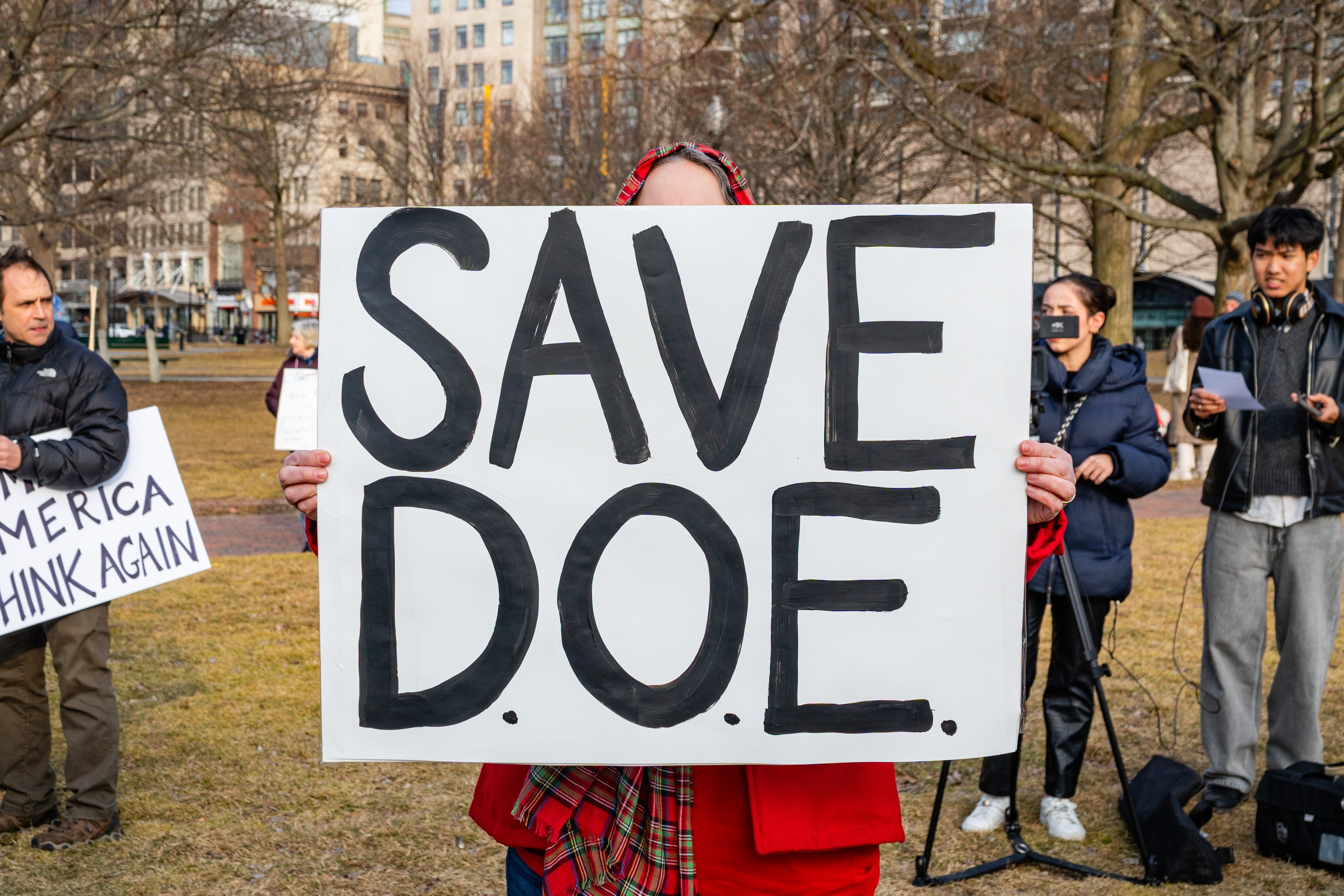
The one that got the most attention on my feeds was the continued dismantling of the Department of Education, with the civil rights in schools functions being shifted to an increasingly hostile-to-civil-rights Department of Justice, and special education moving to the Department of Health and Human Services.
For the record, I think both of these moves, along with the ongoing attacks on our public health system, are terrible ideas.
But I want to be clear: we are seeing this kind of thing happen because people don’t understand the basic functions of institutions, don’t engage with them unless they need them, and, when they do, often don’t get the kind of service that makes them trust the agencies.
I’ve used Mayor/Ambassador Garcetti’s metaphor that our house is on fire. That’s absolutely the case with our federal agencies. But it wouldn’t be if we had been supporting them and building trust with the communities we serve.
And, instead of rebuilding the burning house in the same way, we need, as Garcetti said, the architects to accommodate the needs of the next 30 years, not the past 100.
60 Seconds of History
I tend not to have an immediate negative reaction when any elected official talks about reforming or changing a department.
The idea of a federal agency has been in constant flux since our founding, when we had only three cabinet positions: Treasury, State, and War.
Since then, Departments have been founded, merged, pulled apart again, and even shut down completely.
New Departments have been proposed by Republican and Democratic Presidents, Senators, and even candidates for office, seeking to increase not only efficiency but also awareness of how economic development, technology, the environment, education, and energy overlap.
Many of our current departments have offices that provide very similar services and, in many cases, require a formal joint agency to coordinate resources. FEMA (Federal Emergency Management Agency) is perhaps the most visible to the public.
The point is that throughout the history of our Federal Government, it’s often necessary and wise to reshape agencies to meet the current and future needs of the people.
FDR, who is credited as reshaping the government to be active, understood the need to stay on it so that it served the need of the people: “For nearly four years you have had an Administration which instead of twirling its thumbs has rolled up its sleeves. We will keep our sleeves rolled up. We had to struggle with the old enemies of peace--business and financial monopoly, speculation, reckless banking, class antagonism, sectionalism, war profiteering. They had begun to consider the Government of the United States as a mere appendage to their own affairs. We know now that Government by organized money is just as dangerous as Government by organized mob.”
The critical issue, however, is that we reform in a way that builds rather than erodes trust. Of course, the trust has been eroding for decades, and Trump poured gasoline on it all.
I wrote about the foreign affairs breakdown a few weeks back in Our House Is On Fire. To build international stability, we’re going to need a reset at both the Depts. of State and Defense.
The ongoing dismantling of the EPA’s research office and continual defunding of oversight raise a number of environmental and public health concerns.
And many others have written on the long Listerine Rinse that’s going to have to happen at the Department of Justice. David French wrote a strong opinion piece about the prosecutorial misconduct being driven by this administration. I’ve provided a link with no paywall. That was just this week.
Today’s post, however, will focus a bit more on the agencies that dig deep into our communities.
Where We Are
It’s easy to get lost in the alphabet soup of agencies that serve the public. People trying to live their lives have very little time or appetite to get to know the nuances of federal agencies, the overlap with state and local, and how most of those agencies disburse money through local charities, in some cases, churches.
All of that leads to widespread confusion and enables those who want to tell a negative narrative about the federal government to spin things to justify things like DOGE.
Keep in mind that foreign aid on the high side is about 1.4% of the federal budget, but when DOGE started the chain saw work, more than 30% of Americans thought that we spent more than 30% of the TOTAL Budget on foreign aid.
I read two things in the past week that got me thinking.
As James Baldwin wrote in The Fire Next Time, which I recommended a couple of weeks back, talking about his interaction with the Nation of Islam,” Elijah Muhammad has been able to do what generations of welfare workers and committees and resolutions and reports and housing projects and playgrounds have failed to do: to heal and redeem drunkards and junkies, to convert people who have come out of prison and to keep them out, to make men chaste and women virtuous, and to invest both the male and female with a pride and serenity that hang about them like and unfaltering light.”
The second from an article in the Atlantic, “The Voters Who Believe Trump Defends Their Values“: “One participant, Sarah, a 30-something mother of three in rural Wyoming, grew up poor, the daughter of a single teenage mom...In 2008, at age 18, she strongly considered voting for Barack Obama for president...The parents of her boyfriend at the time didn’t argue with her. Instead, her future in-laws listened and then asked: Who brought you out of poverty? The answer, Sarah realized, was not the federal government, but her church community–a view that she believed put her closer to the priorities and policies of conservatives rather than Democrats.”
Two quotes similar in nature. A faith group taking on the role that liberals internationally and typically Democrats in America think the government should and could be doing.
Two quotes 80 years apart are not the defining answer to the issue. But both raise questions.
If we are honest about why people turn to the church rather than the government, we have to be honest about what the agency failed to do and why restoring it won’t be enough.
“Movement” progressives (and I end up in this camp a lot) tend to simultaneously want foundations to provide unfettered money to those “proximate to the issues” to solve problems, while also insisting that the Federal Government’s agencies shouldn’t change.
We don’t push hard enough to force the changes we encounter daily with these agencies, ranging from the application process and long, often opaque decision-making timelines to the onerous reporting requirements if something gets funded. And that’s all, subject to shift every four years with changes in administrative prerogatives.
Conservatives, on the other hand, cite examples from Baldwin and the Atlantic as proof that faith communities and nonprofits can solve the problems. They can’t. Despite what seems like large amounts of money, the nonprofit sector - including faith organizations - doesn’t have enough to meet the need.
Furthermore, conservatives aren’t honest about the amount of money that flows through block grants to states to faith-based organizations. It’s entirely plausible that the answer to the in-laws in Wyoming is that the church helped the young woman with federal funds distributed to the states.
The bottom line is that when we see things aren’t working for people, we need to change the system from the ground up.
I’ve been tracking complaints about how government does or doesn’t function at every level for decades through polling, constituent complaints, and, most obviously, the continual back-and-forth flips between parties.
America is not alone in flip-flopping. With the resignation of Keir Starmer, Britain is on the cusp of its 7th Prime Minister in 10 years.
The common denominator is that far too many people feel left behind, while a very few propel themselves to wealth unseen in human history.
Whatever we’ve been doing needs to adapt to, as someone said at a conference I recently attended, “use policy and power to actually help people.”
That’s a great line for a fireside chat on a panel. But what does it actually look like?
What’s Next?
As I’ve been saying for more than a year, one party wants to rip down institutions, but has no plan to replace them other than to let a very, very wealthy minority call the shots.
If voters had any illusions that the current regime would make things better, we now have more than ample evidence that it literally doesn’t care to try.
Most recent example? Trump’s tantrum and refusal to sign the hugely bipartisan and smart affordable housing bill.
That means, if you care about actually making changes that matter to everyday people, we need to elect Democrats to Congress and the White House.
But the Democrats can’t be where we have been for the past 10 years, just running against something. And we can’t pretend that we’re going to replace the institutions in their former form, nor should we.
In my time in politics, policy, corporate work, and nonprofit (especially foundation) work, the changes that stick are when there’s deep listening to the end recipient but combined with the history of what’s worked and hasn’t along with what we haven’t tried, and people in power, and yes, with money, to make the judgement call to try a new approach.
Those changes often start at the local level, reach the state level, and then expand. If we do it right, we learn along the way.
That puts the Federal government in a clearer position than today. Its primary role is to mobilize national defense and diplomacy to keep us safe, and that should continue.
But domestically, I’m advocating for a reshifting of responsibilities. To do that effectively and efficiently, some department functions should be consolidated over time. But I’m suggesting we don’t start there. Instead, we start from the local level.
Learning from the Guggenheim Museum Bilbao
An example of what I mean is in Spain, where the Basque Government established Bilbao Metropoli-30, with more than 140 organizations and 30 municipalities. The public-private partnership includes academic institutions, companies, foundations, and corporate involvement.
They created a vision that moved Bilbao beyond its industrial history to an economy that supports the next generation. It included long-term strategic planning for the economy, urban regeneration, investments in economic drivers such as advanced manufacturing and renewable energy, and pulling the region together through better-coordinated public transit.
All the while focusing on the quality of life of its citizens. And that included ensuring great experiences that broadened the citizenry’s worldview through investments in cultural venues, such as the Guggenheim Museum Bilbao. The museum is a global destination and a symbol of the city’s transformation.
A Big What If in America
What if, instead of creating plans in DC, America shifted to hundreds of regional plans that more effectively connected urban, suburban, and rural economies across geographies?
The Federal government, in this process, would be the primary aggregator of funds through fair taxation, distribute those funds through mechanisms with accountability, but not so onerous a reporting that it inadvertently creates government-funded monopolies, ensure civil rights and fairness across states and localities, and dig in to make sure the money gets to where it needs to go.
The Feds would also share what’s working and not across the public-private partnerships.
After a period of evaluation, say, five years, we’d be in a much better position to discuss what types of changes we’d need to make to federal agencies, not only in terms of consolidating efforts, but also where those should be placed (DC or in the interior of the country).
The absolute challenge to this is the mood of the American people (and world population) who have demonstrated zero patience for any kind of rational approach, wanting changes on “day one” which continue to disappoint.
But I’d say, to that, we just start at the local level anyway. Some regional entities have tried to do it in America, but have been underresourced.
In my backyard, in Kansas City, we have the mechanisms to do this very thing, but we will need a far more coordinated effort across the two states to draw down federal and state resources through existing channels to show what’s possible.
That will require corporations and foundations to work in a more cohesive approach than ever before. Improbable, yes. Impossible, no.
Kansas City is just one example of what’s possible when regional coordination is actually supported. Imagine if we multiply that across the country with the resources of the federal government.
If Not at our 250th, When?
As we head into the final days leading up to the 250th Anniversary of our Founding, this is the time to rethink our entire approach to governance.
I started this series reflecting on FDR’s Economic Bill of Rights. I want to go back to an earlier quote from his April 14, 1938, Fireside Chat, “But I conceive the first duty of government is to protect the economic welfare of all the people in all sections and in all groups.“
You’ll note he doesn’t only say “federal government.” As a former governor, FDR recognized the need for states and local governments to be partners in the puzzle. Yet he also felt that the federal government could set the pace for all players, including private enterprise.
We need that level of energy, experimentation, and a bit of patience to get through our current malaise.
A time to begin the slow process of rebuilding trust through delivering actual results. My firm belief is that we begin at the block level and keep building up for durable change.
Instead, we’re just shifting deck chairs on the Titanic and not addressing the issues Baldwin and the Atlantic article raised.
Reading Recommendations
I read a lot to learn a lot.
I’m going to dust off my copy of Michael Lewis’ The Fifth Risk, which examined how Trump’s actions in his first term undermined trust and our safety. I’m hoping he writes an update soon. This second term makes the first look like a fuzzy bunny.
For a slightly different take on my topic today, check out Lauren Hall’s Substack post, Universal Governance Design: Institutions must be trustworthy, not just trusted. Here are a couple of lines that I personally agree with: Trust is built the way a bridge earns its reputation: crossing by crossing. You drive over it and nothing happens. You drive over it a thousand more times and nothing happens. It sounds like a low bar. But think about how quickly trust erodes.
If you have 10 Minutes...
More and more people have been disenfranchised in the past few weeks. Thankfully, the Administration was blocked from trying to implement its inaccurate and, according to the judge, privacy-rights-trampling database to kick more people off the voting rolls.
It’s beyond frustrating and so contrary to the aspirations of our founding documents.
At a recent American Public Square event, historian Lindsay Chervinsky challenged the audience not just to think about the 250th Anniversary of the Declaration of Independence as a final event.
Rather, think of it as a kick-off to change the direction of the country toward the aspirations of the document, much in the way the generation did in the eleven years between the signing of the Declaration and the Constitution.
To that end, check out my post from a couple of weeks ago about amending the Constitution to better protect our rights.
Chervinsky also called herself a “voting absolutist.” So, in that spirit, I’m reposting the steps to make sure you’re ready to be an active citizen:
Bookmark the League of Women Voters VOTE 411 and stay up to date on election changes.
Set a reminder to check your status every week, especially before registration deadlines.
And if you don’t know how to look up your voter registration status and deadlines at your local election office, Rock the Vote makes it pretty easy.
Great read. A lot of information.